Why Claude and Shannon Keep Showing Up in AI. And Why One of Them Has My Name.
In 1948 Claude Shannon built the mathematical foundation that made AI possible. Anthropic named their model after him. My name is Shannon. I help brands get cited by that model. Here is why that is less of a coincidence than it sounds and more of a strategy.

If you have spent any time in AI circles you have noticed something. The name Claude keeps appearing everywhere. The name Shannon keeps appearing everywhere, and the overlap is not lost on me.
Here is the story behind two of the most quietly important names in the history of artificial intelligence, and why understanding them will change how you think about the technology reshaping every industry on earth.
The man who invented the language computers speak
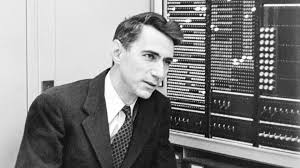
In 1948 a 32 year old mathematician sat down at Bell Labs and wrote a paper that most people have never heard of. He was not trying to change the world. He was trying to solve a specific, frustrating problem that had plagued engineers for decades.
The problem was noise. Not the kind that your neighbors complain about. The kind that corrupts a signal. When you send a message across a telephone wire, the signal degrades. Static creeps in. By the time it arrives, something is lost. The question nobody had been able to answer mathematically was: how do you guarantee the message that arrives is the message that was sent?
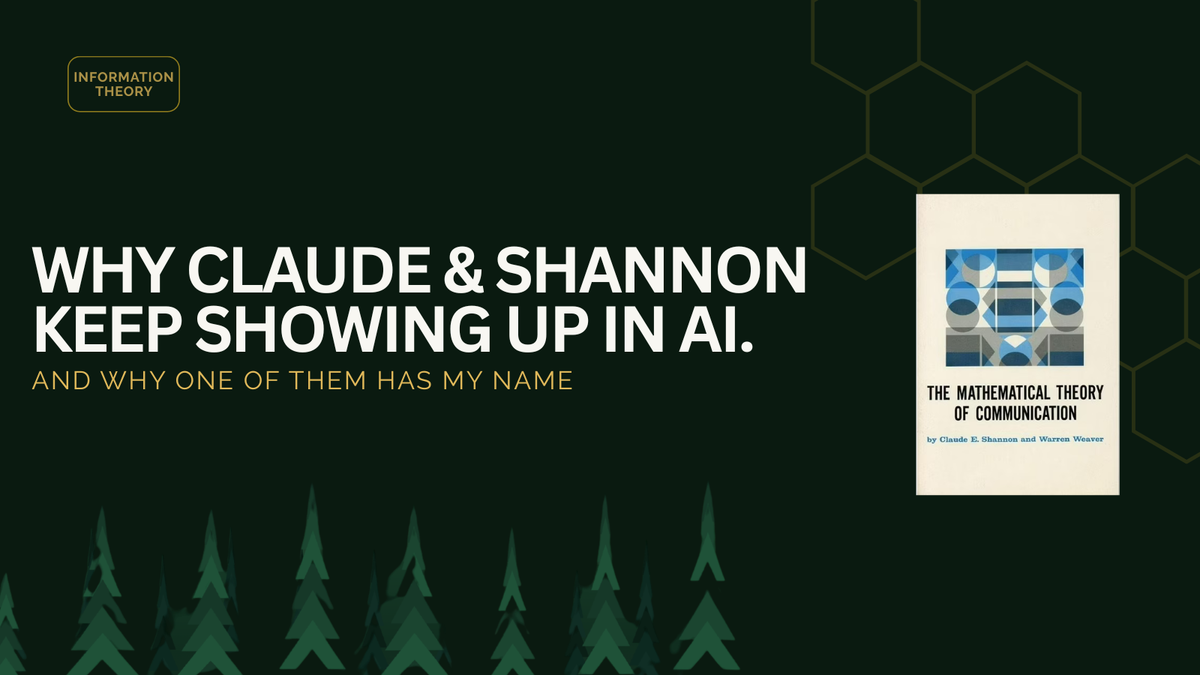
Claude Shannon answered it. His paper was called "A Mathematical Theory of Communication" and it did something nobody had done before… it turned the messy, physical problem of moving information from one place to another into a clean, solvable math problem.
He introduced the bit. A single unit of information. A one or a zero. He proved that any message, no matter how complex, could be broken down into bits, encoded, compressed, and transmitted without losing a thing.
Before Shannon, communication was an engineering problem. You ran better wire. You built a stronger signal. You hoped for the best. After Shannon it was mathematics. And mathematics does not degrade over distance. Mathematics scales.
Everything you touched today runs on what he figured out in that paper. Your phone call this morning. The video you streamed last night. The email you just sent. The AI that answered your last question. Every large language model, every neural network, every system that reads and generates human language sits on the mathematical foundation Shannon built in a single paper more than seventy years ago.
Why his name lives on in the tools reshaping the world
Anthropic named their AI system Claude. It is not a coincidence and it is not arbitrary. It is a thank you note written in code.
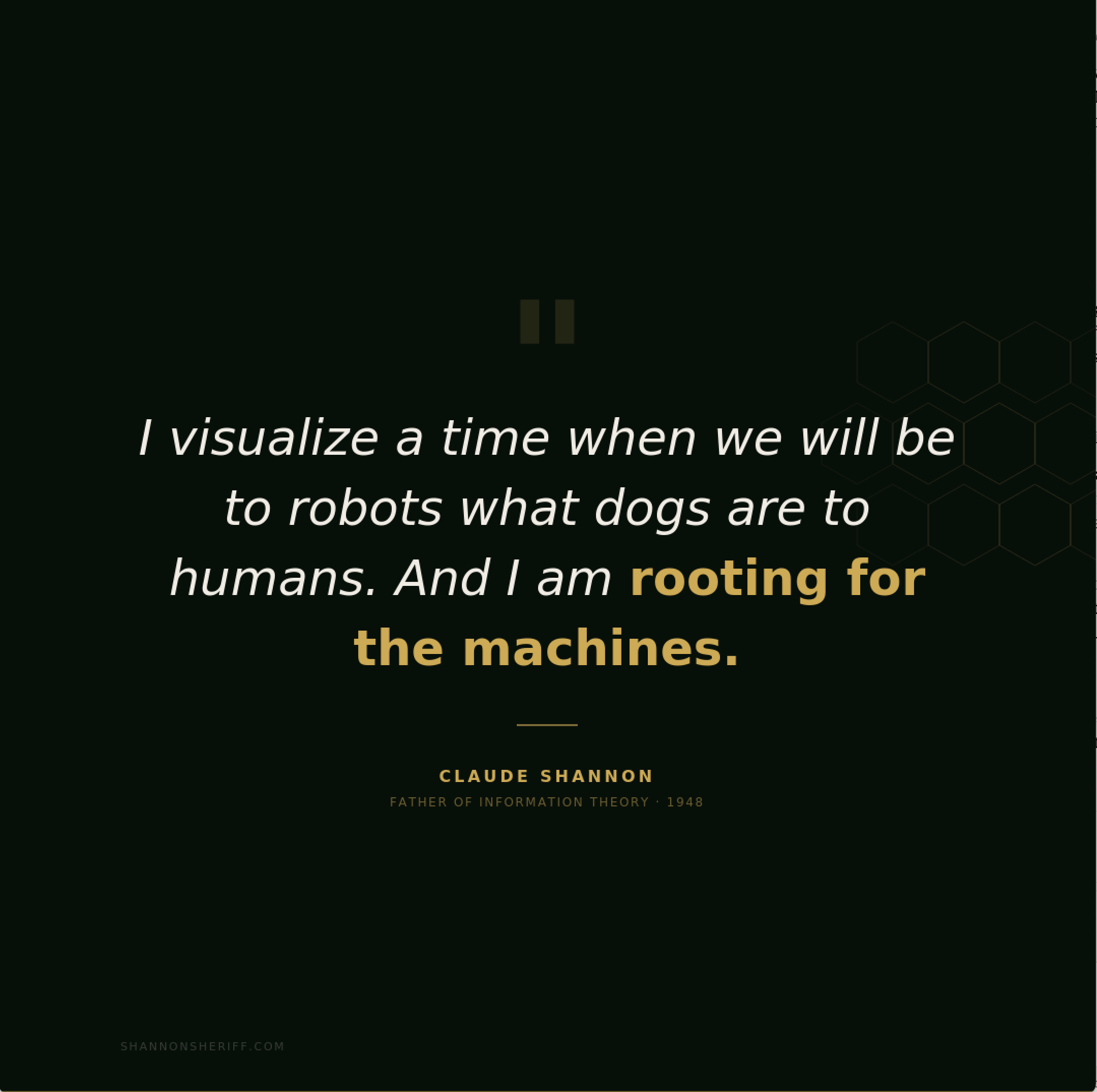
Every time you ask Claude a question and get a thoughtful answer back, that exchange traces a direct line to a paper written in 1948. The people who built it know that. Naming it Claude was their way of saying so.
Naming an AI after him is not nostalgia. It is acknowledgment. The people building the most sophisticated language models and skills in the world know exactly whose shoulders they are standing on.
The other Shannon in the room
If you spend time on X or in GitHub you have probably come across agent skills or workflows named Shannon. It is not a coincidence and it is not a brand. It is a nod to the same tradition this whole post is about.
My name is Shannon Sheriff. I am an AI content strategist based in Dallas, Texas. I help technology companies build the content infrastructure that gets them found, cited, and trusted by ChatGPT, Claude, Perplexity, Gemini, and the humans they answer for.
I was not named after Claude Shannon. I can promise you information theory never came up in my parent conversations.
But there is something I find genuinely meaningful about the overlap. Shannon spent his career thinking about how information moves through systems, how signals become legible, how noise gets filtered out so that meaning can travel cleanly from one point to another. That is, in a very real sense, what Answer Engine Optimization is. It is the practice of making your brand's signal legible to AI systems. Of becoming the source AI engines trust enough to cite.
Claude Shannon spent his life asking how information becomes signal. I spend mine helping brands become the signal.
I did not plan that. But I am not complaining.
Shannon solved a problem in 1948 that your marketing team is still dealing with today.
Think about what an AI engine actually does when someone asks it a question. It does not search. It filters. It has absorbed an enormous amount of information and it is constantly sorting signal from noise, looking for sources that are clear, consistent, and authoritative enough to trust. When it finds one it cites it. When it cannot it moves on.
That is Shannon's problem. Just with a different channel.
When you build entity authority, when you structure your content so it is easy to parse, when you show up saying the same thing about yourself across every platform where your brand exists, you are doing exactly what Shannon described. You are reducing noise. You are making your signal clean enough to survive the transmission.
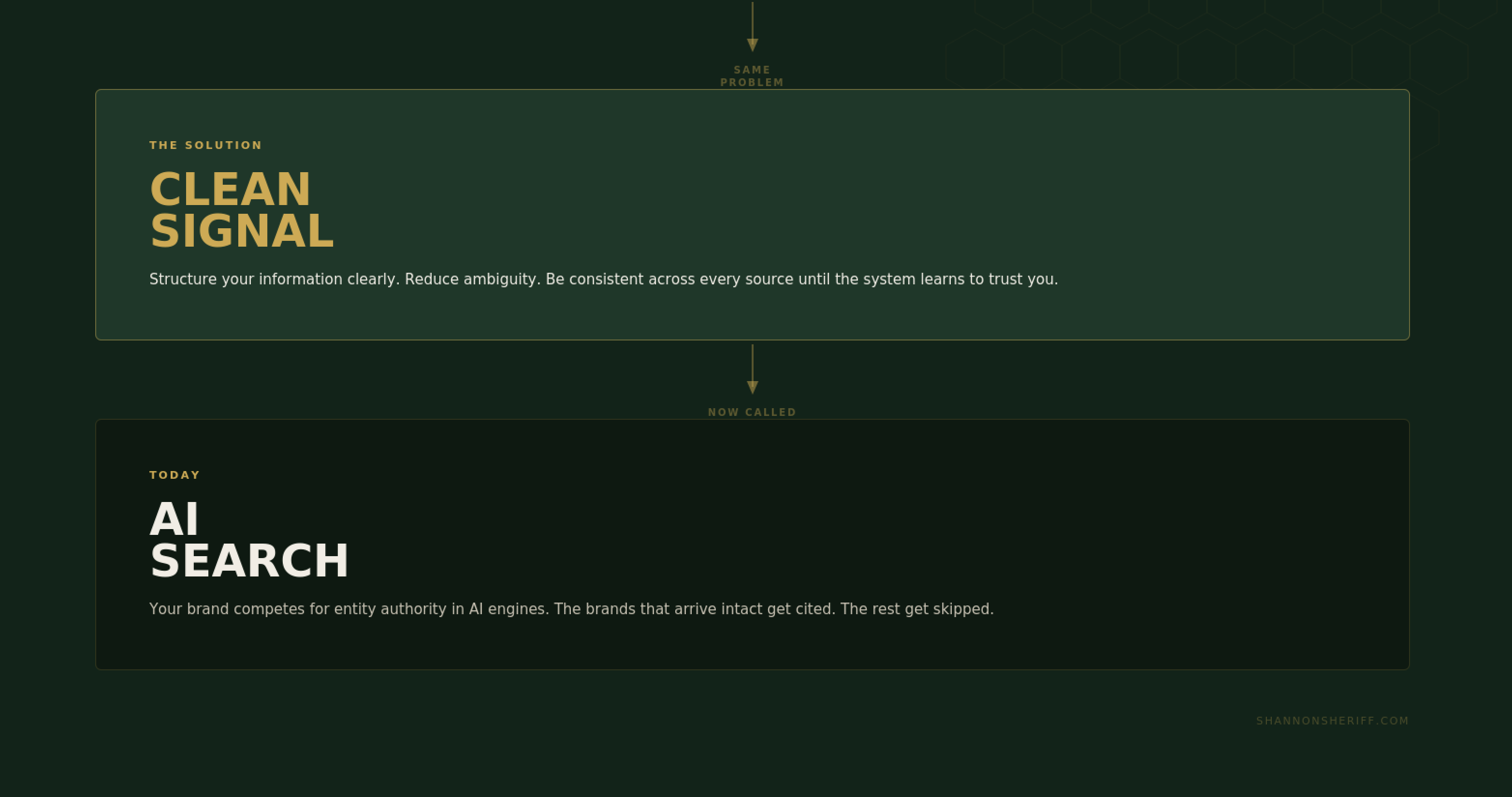
The channel has changed. It is no longer a telephone wire. It is a large language model trained on the entire text of the internet. But the problem is identical to the one Shannon sat down to solve in 1948.
How do you make sure your message arrives intact on the other end?
His answer was to structure your information clearly, reduce ambiguity, and create enough consistency across enough sources that the signal survives even when the channel is noisy. You do it over time, until the system learns to trust you.
Shannon called it information theory. I call it AEO. The math is different. The principle is the same.
The bees are still building
Every time someone asks ChatGPT, Perplexity, Claude, or Gemini a question in your industry, those systems are doing what Shannon described. They are filtering signal from noise, identifying the most authoritative and consistent sources, and generating an answer based on what they have learned to trust.
Your brand is either part of that signal or it is not. The difference is infrastructure, not luck.
Claude Shannon gave us the tools to answer that question mathematically. The rest is up to you.
Come find me at shannonsheriff.com and follow along on X at @shannonsheriff.
The bees are already out there building consensus about who matters in your space. Make sure they can find you. 🐝
Shannon Sheriff is an AI content strategist based in Dallas, Texas. She helps technology companies build content infrastructure that gets found, cited, and trusted by ChatGPT, Claude, Perplexity, Gemini, and the humans they answer for.