Your Brand Does Not Exist to AI Search Engines Yet.Here Is How to Fix That.
Your brand is invisible to ChatGPT, Perplexity, Claude, and Gemini. Not because your content is bad. Because AI search engines build consensus around entity authority, not keywords. This is Answer Engine Optimization and most brands have not started yet.

Imagine you open a restaurant. The food is incredible. The space is warm and inviting. You have regulars who rave about you to anyone who will listen. But somehow, every time someone types "best restaurants near me" into Google Maps, your place does not show up. Not on page one. Not on page five. Nowhere. You exist in real life. You just do not exist to the system deciding who gets found.
That is exactly what is happening to most brands right now with AI search, and almost nobody is talking about it.
ChatGPT has over 800 million weekly active users. Perplexity is processing millions of queries every day. Claude, Gemini, and Microsoft Copilot are increasingly becoming the first stop for research, recommendations, and purchasing decisions. And when someone asks one of these systems "who is the best AI content strategist in Dallas" or "what company can help me with my content strategy," the answer does not come from a keyword ranking. It comes from a consensus built over time across dozens of signals that most brands have never even heard of.
The CEO of Google, @sundarpichai, said it plainly at the New York Times DealBook Summit:
"Search itself will continue to change profoundly. I think we are going to be able to tackle more complex questions than ever before."
What he did not say, but what every brand marketer should be writing on a sticky note above their desk right now, is this: if the system handling those complex questions does not know you exist, it cannot recommend you. Not to anyone. Ever.
Spoiler: it is nothing like Google.
Think of it less like a library catalog and more like a jury deliberation. When someone asks ChatGPT to recommend a content strategist, the system does not go searching in real time for the best answer. It draws from everything it has been trained on and everything it can access, cross-referencing sources, looking for consistency, and building a picture of who is authoritative on a given topic.
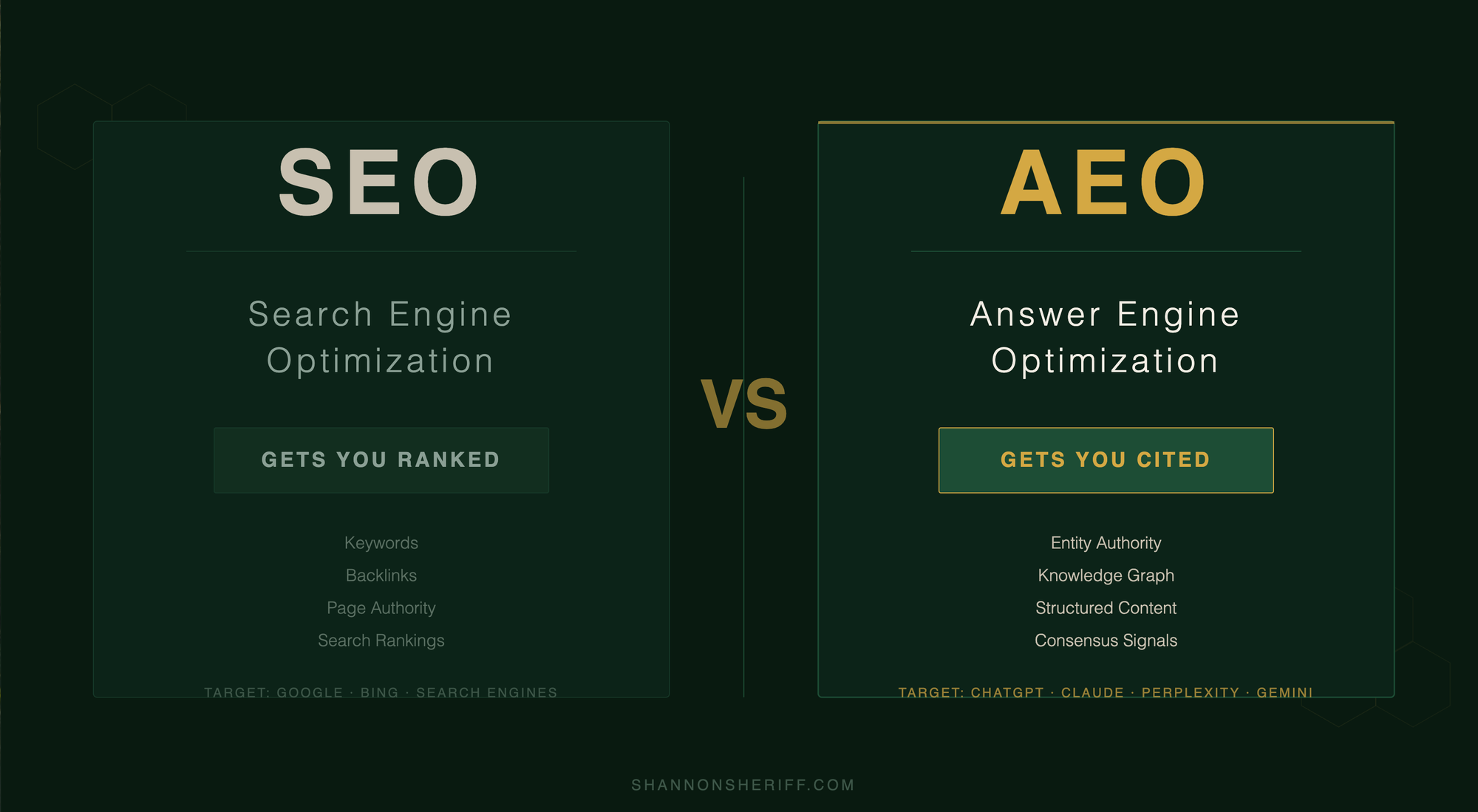
If your name, your expertise, and your credentials appear consistently across your website, your LinkedIn, your published writing, your Wikipedia entry, and other authoritative sources, the jury starts to trust you. If those signals are scattered, inconsistent, or missing entirely, the jury moves on to someone else. This is what Answer Engine Optimization is. Not a trick. Not a hack. A fundamental shift in how authority is established online.
The five things you need to fix right now
⬡ 01. Map your entity. This means your name, your job title, your location, your area of expertise, and your credentials need to be stated clearly and consistently everywhere you exist online. Not approximately. Not in slightly different variations. Exactly the same. AI systems are looking for coherence. Give it to them.
The part nobody wants to hear
David Long was one of my earliest mentors, years before he became a Wall Street Journal bestselling author with Built to Lead. He had a way of cutting straight to the truth. You cannot throw money at a root problem. The faucet keeps running until you fix what is actually broken.
That is exactly what is happening with AI visibility right now. Brands are pouring budget into ads, content volume, and social media management and wondering why AI engines still skip them. They are treating the symptom. The root problem is that AI systems do not know who they are.
You cannot buy your way into an AI citation the way you could buy your way up a Google ranking. There is no ad product. There is no shortcut. The only path is building genuine, consistent, structured authority over time. The brands that start doing this work now will be the ones AI systems are citing in two years. The brands that wait will be asking why they cannot be found.
The good news is that the bar is genuinely low right now. Most brands have done none of this work. Which means if you start today, you have a real window.
Where to start
Begin with your own website. Does it clearly state who you are, what you do, where you are based, and what you are known for? Is that information structured with proper headings and consistent terminology? Does your site have schema markup telling AI systems exactly what kind of entity you are?
If the answer to any of those is no, that is your first task. Get the foundation right before worrying about anything else.
Then look at your social profiles. Open LinkedIn, X, Instagram, and YouTube side by side. Do they all tell the same story? Is your job title consistent? Is your expertise described the same way across all of them?
Start there. Then we go deeper together.
Figure out where your gaps are. Map your entity. Structure your content. Seed your knowledge graph. Set up your AI referral tracking. Build the social media strategy that ties it all together across X, Instagram, TikTok, YouTube, LinkedIn, Substack, and Medium. This is not a one afternoon project. It is an infrastructure build. And like any infrastructure, it compounds over time.
If you want someone who has actually built this, not just written about it, that is what I do. I work with technology companies to build the content infrastructure that gets them found, cited, and trusted by ChatGPT, Claude, Perplexity, Gemini, and the humans they answer for.
The bees are already out there building consensus about who matters in your space. Make sure they can find you. Come find me at shannonsheriff.com and follow along on X at @shannonsheriff.

